


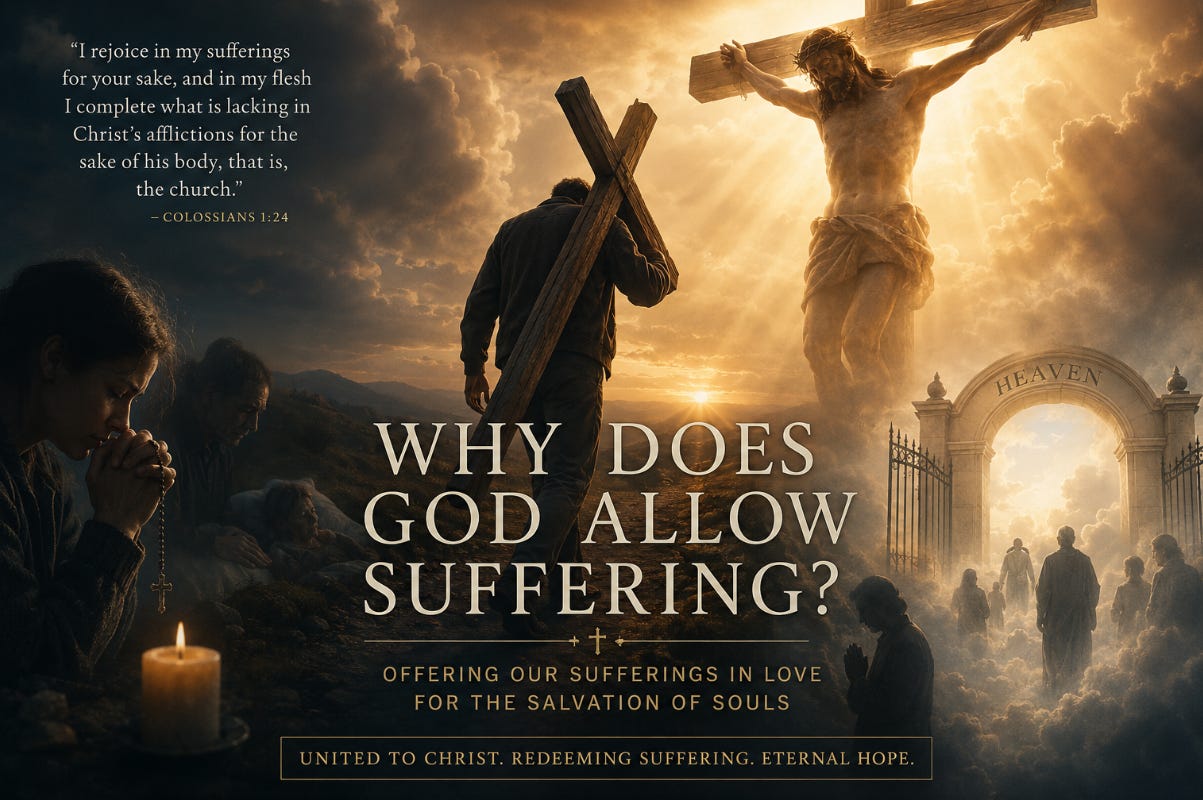
There are few questions more difficult, more personal, or more universal than this:
Why does God allow suffering?
Every human heart asks it eventually. We ask it standing beside hospital beds. We ask it while mourning loved ones. We ask it in moments of betrayal, loneliness, addiction, anxiety, poverty, illness, and spiritual darkness. Even faithful Christians sometimes whisper the question through tears:
“Lord, where are You?”
The modern world often interprets suffering as proof against God. If God is all-good and all-powerful, people ask, then why would He permit pain?
Yet Catholic theology offers an answer unlike any other worldview. Christianity does not deny suffering. It does not romanticize it. It does not pretend pain is illusion. Instead, the Catholic faith boldly proclaims something astonishing:
God entered into suffering Himself.
The answer to suffering is not found in abstract philosophy alone. It is found in the Cross of Jesus Christ.
As Archbishop Fulton J. Sheen once wrote:
“Unless there is a Good Friday in your life, there can be no Easter Sunday.”
The Cross stands at the center of human history because suffering, united to Christ, is no longer meaningless. Through Christ, suffering can become redemptive.
This truth is difficult for modern ears because contemporary culture worships comfort, convenience, entertainment, and self-preservation. We are taught to avoid suffering at all costs. But Catholicism teaches that suffering—when united to Christ—can purify the soul, deepen holiness, strengthen love, and even assist in the salvation of others.
That does not mean suffering itself is good. Evil, death, disease, and sin entered the world through the Fall. God did not create suffering as part of His original design. Scripture tells us clearly:
“God did not make death, and he does not delight in the death of the living.” — Wisdom 1:13
Yet God, in His providence, permits suffering because He can draw a greater good from it than we can presently understand.
The supreme example is Calvary.
The greatest evil ever committed—the crucifixion of the innocent Son of God—became the source of the world’s salvation.
Christ Did Not Explain Away Suffering—He Transformed It
Jesus never promised His followers an easy life.
In fact, He promised the opposite:
“If any man would come after me, let him deny himself and take up his cross daily and follow me.” — Luke 9:23
The Christian life is not the avoidance of the cross; it is learning how to carry it with Christ.
Bishop Robert Barron often emphasizes that Christianity is not a religion of self-help or worldly success. It is participation in the divine life through self-sacrificial love. Bishop Barron frequently points to the paradox at the center of the Gospel:
We save our lives precisely by giving them away.
That is why suffering can become transformative. Love always involves sacrifice. A mother suffers for her child. A father sacrifices for his family. Soldiers suffer for their nation. Saints suffer for souls.
Christ revealed that sacrificial love is the deepest reality of heaven itself.
At the Cross, Jesus took suffering—the very consequence of sin—and transformed it into a vehicle of redemption.
Saint Paul writes:
“I rejoice in my sufferings for your sake, and in my flesh I complete what is lacking in Christ’s afflictions for the sake of his body, that is, the church.” — Colossians 1:24
This passage often confuses people. How could anything be “lacking” in Christ’s sufferings?
The Church teaches that Christ’s sacrifice is fully sufficient for salvation. Nothing can be added to the infinite value of Calvary. Yet God permits believers to participate in Christ’s redemptive work through union with Him.
In other words, Christ allows our suffering to matter.
He dignifies human pain by inviting us to unite it to His Cross.
This is what Catholics call redemptive suffering.
The Witness of the Early Church Fathers
The early Church Fathers understood suffering not as divine abandonment but as spiritual purification and participation in Christ.
Saint Ignatius of Antioch, on his way to martyrdom in Rome around A.D. 107, wrote:
“Permit me to imitate the passion of my God.”
To modern ears, such words sound shocking. But Ignatius understood that suffering united to Christ could sanctify the soul.
Likewise, Augustine of Hippo taught that God permits evil only because He can bring forth a greater good:
“God judged it better to bring good out of evil than to suffer no evil to exist.”
The Fathers consistently viewed earthly suffering as preparation for eternal glory.
Saint John Chrysostom preached:
“The trials of this present life are not worthy to be compared with the glory which shall be revealed.”
This echoes Saint Paul:
“For this slight momentary affliction is preparing for us an eternal weight of glory beyond all comparison.” — 2 Corinthians 4:17
The saints understood something modern culture forgets:
Earth is not heaven.
We are pilgrims journeying toward eternity.
Why Must Souls Be Purified?
One of the most misunderstood teachings in Christianity is the Catholic doctrine of purgatory.
Many assume purgatory means Catholics doubt Christ’s salvation. But the opposite is true. Purgatory exists precisely because salvation in Christ is real.
Scripture teaches clearly that nothing unclean can enter heaven:
“Nothing unclean shall enter it.” — Revelation 21:27
God is perfectly holy. Heaven is perfect union with Him. Yet many souls die in friendship with God while still attached to sin, selfishness, pride, or the temporal effects of forgiven sin.
Purgatory is not a second chance after death.
It is the final purification of those already saved.
The Catechism of the Catholic Church teaches:
“All who die in God’s grace and friendship, but still imperfectly purified, are indeed assured of their eternal salvation; but after death they undergo purification.” (CCC 1030)
This purification is rooted in Scripture.
Saint Paul writes:
“If any man’s work is burned up, he will suffer loss, though he himself will be saved, but only as through fire.” — 1 Corinthians 3:15
Notice the important detail: the person is saved, yet still purified.
The Jewish people also prayed for the dead long before Christ:
“Therefore he made atonement for the dead, that they might be delivered from their sin.” — 2 Maccabees 12:46
This passage is foundational for Catholic teaching on prayers for the dead.
The early Christians continued this practice from the beginning.
Tertullian wrote in the second century about prayers and sacrifices offered for the faithful departed.
Cyril of Jerusalem taught:
“We pray for the holy fathers and bishops who have fallen asleep, believing that this will be of great benefit to the souls.”
The Church has always believed that the faithful on earth can assist the souls undergoing purification.
Offering Our Suffering for Souls in Purgatory
One of the most beautiful dimensions of Catholic spirituality is the belief that our prayers, sacrifices, and sufferings can assist others.
This is part of the Communion of Saints.
The Church is not merely an earthly institution. It is a supernatural family united across heaven, earth, and purgatory.
When Catholics “offer up” suffering, they unite their pain to Christ for a spiritual purpose.
This can include:
The conversion of sinners
Healing for loved ones
Strength for the Church
Reparation for sin
Relief for the holy souls in purgatory
Again, this is not because Christ’s sacrifice is insufficient. Rather, God lovingly allows us to participate in His redemptive mission.
Archbishop Fulton J. Sheen preached often on this mystery. He warned against wasting suffering.
He famously observed:
“Pain is not a curse. It is the megaphone that God uses to rouse a deaf world.”
Sheen believed suffering either makes us bitter or holy depending on whether we unite it to Christ.
Every cross can become an altar.
Every sorrow can become prayer.
Every tear can become intercession.
The saints understood this profoundly.
Thérèse of Lisieux quietly offered hidden sufferings for souls and missionaries. Padre Pio endured immense physical suffering while praying constantly for souls in purgatory.
The Church teaches that acts of love, sacrifice, penance, fasting, almsgiving, and prayer can aid the faithful departed because all grace flows through Christ and His mystical Body.
Suffering Purifies Love
One of the deepest truths of Catholic spirituality is this:
God is not merely trying to make us comfortable. He is trying to make us saints.
And sainthood requires purification.
Gold is purified through fire.
The soul is often purified through suffering.
Saint Peter writes:
“Now for a little while you may have to suffer various trials, so that the genuineness of your faith, more precious than gold… may redound to praise and glory.” — 1 Peter 1:6–7
Suffering reveals what we truly love.
It strips away illusions of self-sufficiency.
It humbles pride.
It exposes idols.
It teaches dependence on God.
Often, the people closest to God are those who have suffered deeply.
Not because suffering itself is holy, but because suffering can open the soul to grace in ways comfort never will.
Bishop Robert Barron frequently notes that the saints are not people who avoided pain. They are people who allowed God to transform pain into love.
The Cross is therefore not merely an event in history.
It is the pattern of Christian life.
Death to self.
Resurrection through grace.
The Danger of a Comfort-Obsessed Culture
Modern society increasingly treats suffering as meaningless interruption. We seek endless distraction because silence often forces us to confront mortality, sin, and eternity.
But Christianity insists that suffering can become spiritually fruitful.
Without this understanding, suffering often leads to despair.
With Christ, suffering can lead to sanctification.
This is why the Church has always valued fasting, penance, self-denial, and sacrificial living—not because the body is evil, but because disciplined sacrifice trains the soul for eternal realities.
Christ Himself fasted.
The apostles suffered persecution.
The martyrs embraced death rather than deny Christ.
The saints accepted suffering not masochistically, but lovingly.
They saw beyond this life.
As Saint Paul reminds us:
“Our citizenship is in heaven.” — Philippians 3:20
The Hope Beyond Suffering
Christianity never ends with suffering.
The Cross always points toward resurrection.
One of the great mistakes people make is imagining heaven as merely an extension of earthly pleasures. But heaven is infinitely greater: eternal union with God Himself.
Every earthly sorrow will one day be healed.
Scripture promises:
“He will wipe away every tear from their eyes, and death shall be no more.” — Revelation 21:4
The wounds of this life are not ignored by God.
They are redeemed.
Christ still bears His wounds after the Resurrection. Why? Because transformed suffering becomes glory.
This is the Christian hope.
Not that suffering disappears immediately.
But that suffering, united to Christ, is never wasted.
Final Reflection
Why does God allow suffering?
Because He respects human freedom.
Because sin wounded creation.
Because love requires sacrifice.
Because suffering can purify the soul.
Because through suffering united to Christ, souls can be sanctified and even assist others on the journey toward heaven.
Most importantly, because God chose not to remain distant from human pain.
He entered it.
At Calvary, God Himself suffered.
And because of that, suffering no longer has the final word.
The Resurrection does.
For the faithful Christian, every cross carried with Christ becomes preparation for glory.
Every suffering offered in love becomes participation in redemption.
Every act of sacrifice echoes into eternity.
And every purified soul journeys toward the Beatific Vision—the eternal joy of seeing God face to face.
Until then, the Church continues to pray:
Eternal rest grant unto them, O Lord,
and let perpetual light shine upon them.
May the souls of the faithful departed, through the mercy of God, rest in peace. Amen.
References
Aquinas, T. (1947). Summa theologica (Fathers of the English Dominican Province, Trans.). Benziger Brothers. (Original work published 1265–1274)
Augustine of Hippo. (1998). Enchiridion on faith, hope, and love (B. Ramsey, Trans.). New City Press. (Original work published ca. A.D. 421)
Barron, R. (2015). Catholicism: A journey to the heart of the faith (2nd ed.). Image Books.
Barron, R. (2019). Letter to a suffering church: A bishop speaks on the sexual abuse crisis. Image Books.
Catechism of the Catholic Church. (2nd ed.). (1997). Libreria Editrice Vaticana.
Chrysostom, J. (1889). Homilies on the Epistles of St. Paul to the Corinthians. In P. Schaff (Ed.), Nicene and Post-Nicene Fathers, First Series (Vol. 12). Christian Literature Publishing Co.
Cyril of Jerusalem. (1970). Catechetical lectures (E. Yarnold, Trans.). Paulist Press.
Holy Bible, Revised Standard Version Catholic Edition. (2006). Ignatius Press. (Original work published 1966)
John Paul II. (1984). Salvifici doloris (On the Christian meaning of human suffering). Libreria Editrice Vaticana.
Ignatius of Antioch. (2007). The letters of St. Ignatius of Antioch. In M. W. Holmes (Ed. & Trans.), The Apostolic Fathers: Greek texts and English translations (3rd ed.). Baker Academic.
Kreeft, P. (1986). Making sense out of suffering. Servant Books.
Ratzinger, J. (Pope Benedict XVI). (2007). Spe salvi (Saved in hope). Libreria Editrice Vaticana.
Sheen, F. J. (1938). The cross and the beatitudes. P. J. Kenedy & Sons.
Sheen, F. J. (1953). Life of Christ. McGraw-Hill.
Sheen, F. J. (1977). Through the year with Fulton Sheen: Inspirational selections from his writings. Servant Books.
Tertullian. (1950). Treatise on monogamy. In A. Roberts & J. Donaldson (Eds.), Ante-Nicene Fathers (Vol. 4). Eerdmans. (Original work published ca. A.D. 213)
United States Conference of Catholic Bishops. (n.d.). Purgatory.
https://www.usccb.org
Vatican Council II. (1964). Lumen gentium (Dogmatic Constitution on the Church). Libreria Editrice Vaticana.
About Dr. Currie Myers
Dr. Currie Myers is a national Catholic speaker, author, and evangelist whose mission is to reignite the pillars of faith, family, and formation in the hearts of Catholics and in the fabric of society. A former agnostic, Dr. Myers experienced a powerful conversion through the grace of intercessory prayer and the charism of hospitality, leading him to rediscover his ancestral Catholic roots reaching back to the earliest days of Catholicism in America.
Known as “America’s Criminologist,” Dr. Myers brings a unique blend of faith, leadership, and scholarship to his ministry. He formerly served as a faculty member in the Department of Criminology at Benedictine College for 14 years, a renowned Catholic institution dedicated to forming students in both intellect and virtue. Through his academic work, Dr. Myers explores the intersection of criminal justice ethics, public policy, and Catholic social teaching.
He is a featured speaker with the Catholic Speakers Organization, and presents on topics including conversion, spiritual warfare, Catholic fatherhood, and moral leadership. Dr. Myers is the author of The Advent of Feral Man and publishes through two platforms—one focusing on faith, family, and formation; the other on applied criminology rooted in Christian ethics. His passion is to equip individuals and families with the spiritual armor of God, promoting truth, discipline, and authentic love in a world marked by confusion and division.


